Climatic Adaptation on the Slope
Altitude amplifies weather. A settlement on a mountain face is exposed to high-velocity winds, rapid temperature fluctuations, heavy snow loads, and the kinetic threats of avalanches and rockfalls. Surviving these elements requires deliberate architectural geometry and precise site selection.
Solar Orientation and Thermal Mass
The cardinal direction a slope faces dictates its habitability. In the Northern Hemisphere, south-facing slopes receive significantly more solar radiation. Villages such as Wengen in Switzerland are strategically situated on these sun-exposed terraces. The buildings are arranged to avoid casting shadows on each other during the low-angle winter sun.
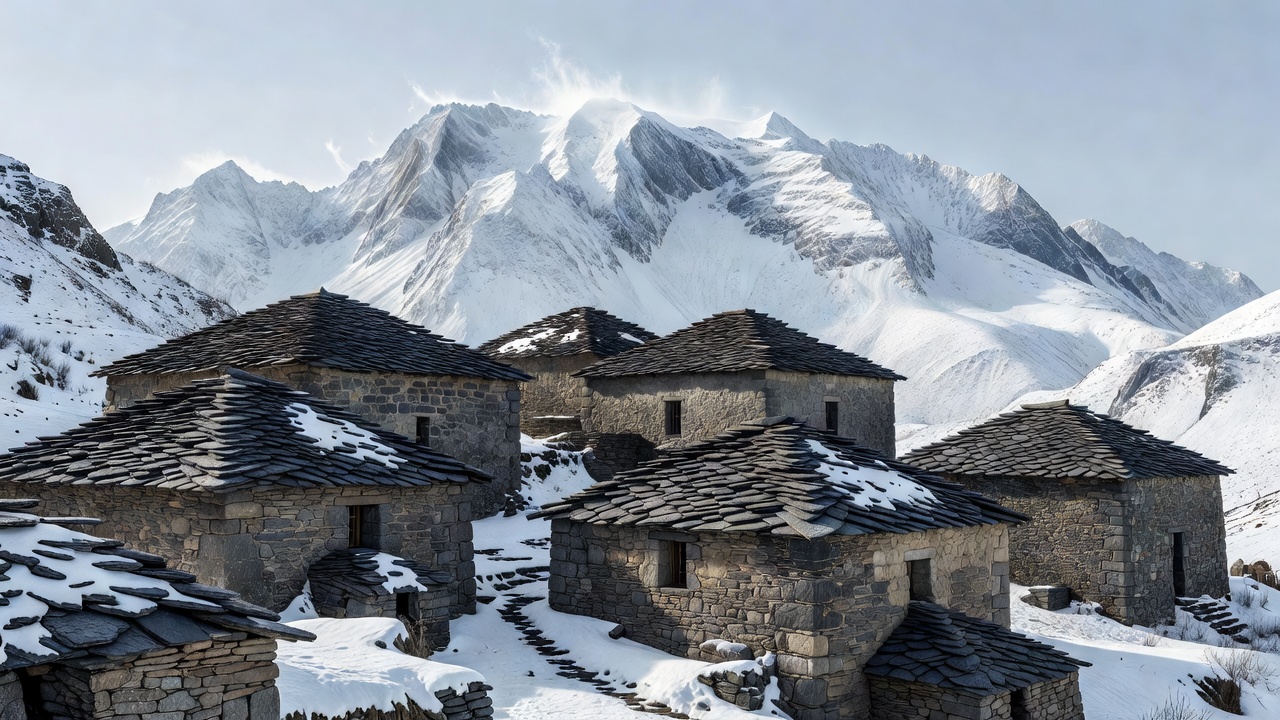
Materials play a crucial role in thermal regulation. Thick stone walls possess high thermal mass. During the day, they absorb solar heat; at night, as temperatures plummet, they slowly release this heat into the interior. Small windows, deeply inset into the walls, minimize heat loss while preventing cold katabatic winds from penetrating the dwelling.
Managing Wind and Snow Loads
High-altitude settlements face severe wind shear. Katabatic winds, which pull dense, cold air rapidly down the mountain surface, can easily damage exposed structures. To counter this, villages are often built in dense clusters, presenting a unified, aerodynamic block to the wind rather than a series of isolated targets.
Snow management heavily influences roof design. Alpine chalets typically feature overhanging eaves. These protect the foundational walls from moisture and keep the entrance clear of snowdrifts. The pitch of the roof is carefully calculated: it must be steep enough to shed dangerous accumulations that could collapse the structure, but shallow enough to hold a moderate layer of snow, which acts as an excellent natural insulator against the sub-zero air outside.
Deflection Architecture
In avalanche-prone corridors, positioning is a matter of life and death. Villages avoid natural chutes where snow and rocks channel downward. Where exposure is unavoidable, specific architectural defenses are employed. Some structures feature heavily reinforced, wedge-shaped uphill walls designed to split and deflect snow flows around the building, similar to the prow of a ship parting water.
What are katabatic winds?
A katabatic wind is a drainage wind that carries high-density, cold air from a higher elevation down a slope under the force of gravity. They can reach hurricane speeds, requiring buildings to be heavily anchored and structurally sealed on the uphill side.
Why do alpine roofs have heavy stones on them?
Historically, flat stones were placed on timber or slate roofs to prevent the roofing material from being lifted off by extreme updrafts and mountain gales. They also help distribute the weight of accumulated snow evenly across the rafters.