Terraced Sustenance
A mountainside village cannot exist solely as a defensive redoubt; it must feed its population. However, slopes present a dual agricultural crisis: rapid topsoil erosion during precipitation and an inability for water to pool for root absorption. The anthropological record demonstrates that the primary response to this crisis is the alteration of the topography itself via terracing.
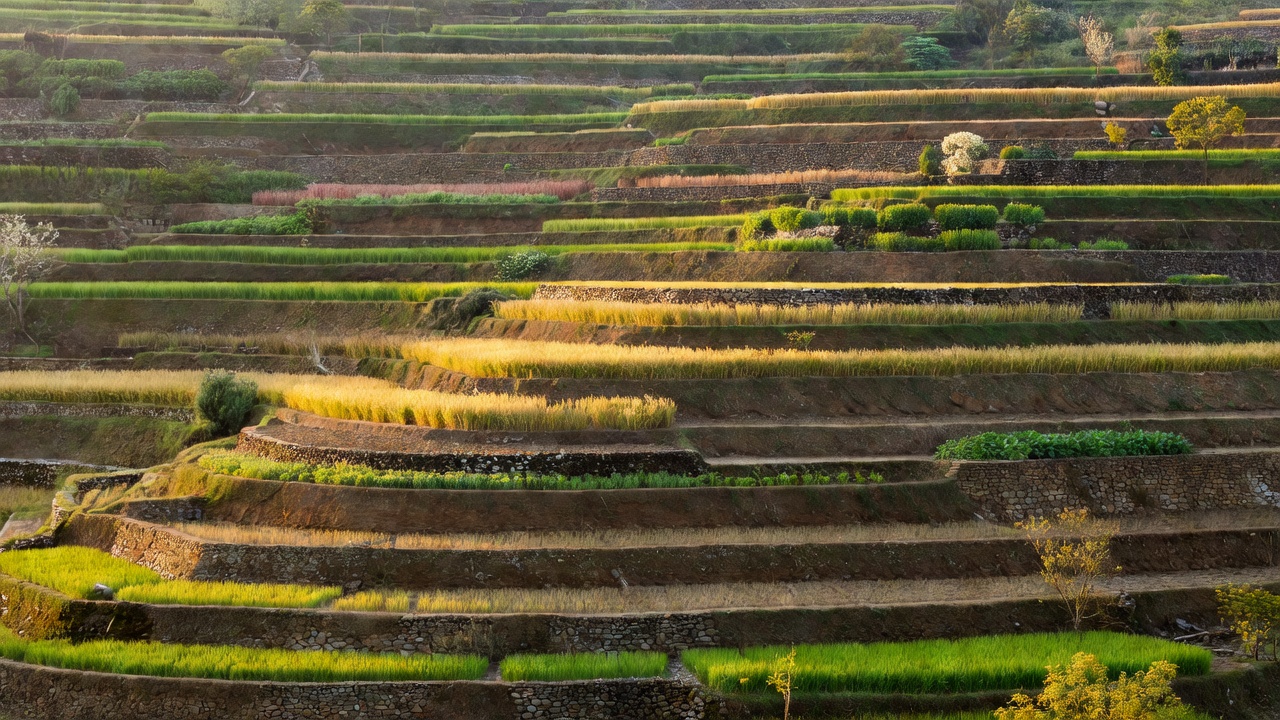
The Geometry of Terracing
The construction of agricultural terraces is a multi-generational labor investment. A retaining wall is built along the contour line of the hill, and the area behind it is backfilled with soil and gravel. This creates a level planting surface. In the Philippine Cordilleras, the Ifugao people maintained complex rice terraces for centuries, manipulating hydrology to ensure continuous, gentle flow across steps.
Terraces function primarily as hydrological brakes. When rain falls on a natural 40-degree slope, it accelerates downward, carrying vital topsoil with it. By breaking the slope into a series of flat platforms, water velocity is arrested. The water has time to percolate downward into the soil profile, providing moisture to crops while the stone retaining walls hold the earth in place.
Gravity-Fed Irrigation Systems
Securing water on a mountain usually means tapping a source higher up the peak. Gravity is both the threat and the tool. Villages often construct complex aqueduct and channel systems—such as the levadas of Madeira or the falaj networks in Oman—to route water from high springs down to the agricultural plots.
These channels must maintain a very slight, highly precise gradient. If the water flows too fast, it erodes the channel; if it flows too slow, sediment blocks the pathway. Maintaining these watercourses is typically a communal obligation, tightly linking the agricultural survival of the village to its social cohesion.
Microclimates and Crop Placement
Verticality creates diverse microclimates within a very small geographic footprint. Temperature drops as elevation increases, and solar exposure varies dramatically depending on the orientation of the slope. In the Douro Valley of Portugal, terraced vineyards are positioned precisely to maximize solar radiation during the day, while the stone walls themselves absorb heat. At night, the stone radiates this heat back out, protecting the vines from frost.
Farmers historically mapped these microclimates with precision, planting hardy grains like barley on higher, wind-swept terraces, and reserving lower, sheltered plots for frost-sensitive vegetables and fruits.
What is topsoil retention?
Topsoil is the nutrient-rich upper layer of earth. On steep gradients, gravity and water quickly wash it away. Terracing involves building physical barriers (stone walls) that trap the soil, creating a permanent, flat growing bed that retains nutrients over decades of use.
How is water distributed across terraces?
Water is channeled from a high source and directed to the top terrace. It slowly floods the level ground, and overflow is directed through specific stone spillways down to the next level. This controlled descent prevents the wall-damaging buildup of hydrostatic pressure.